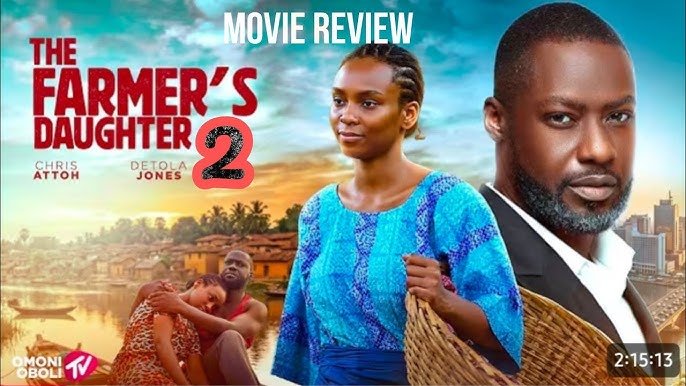

Streaming on YouTube | Runtime: 2 Hours 15 Minutes
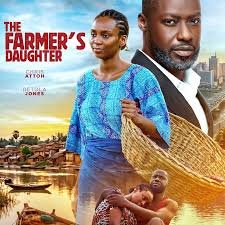
Starring: Detola Jones, Chris Attoh, Angel Ufuoma, and others
When a film stretches beyond two hours, it either earns its length or loses the audience halfway through. Farmer’s Daughter, currently streaming on Omoni Oboli’s YouTube platform, manages to stay emotionally grounded for most of its runtime by leaning heavily on character-driven storytelling and strong performances, even when a few narrative choices feel uneven.
At its core, the movie explores emotional pain within family structures, shifting attention away from the usual one-sided portrayal of abuse. Instead of focusing only on women’s suffering, it briefly opens the conversation to the often-ignored reality of men who also experience emotional entrapment in relationships but remain silent due to societal expectations. That angle alone gives the film a slightly different tone from typical Nollywood domestic dramas.
The story also digs into guilt, emotional breakdown, and long-term consequences of unresolved trauma within families, particularly through Morenike and Chima’s intertwined journeys. While the narrative occasionally slows down, it ultimately builds toward a hopeful resolution where Morenike finds emotional balance and a love that is not rooted in pressure or survival, but in healing and understanding.
Performances That Carry The Film
Detola Jones stands out as Morenike. Her performance is not exaggerated or overly theatrical; instead, it feels controlled and emotionally intentional. One of the strongest aspects of her role is how she communicates pain without constantly verbalising it. There is a moment around the mid-film mark where her emotional restraint breaks slightly, and it becomes clear she fully understands the depth of her character’s suffering.
Her crying scenes are not just emotional cues; they feel lived-in, especially when her voice trembles in moments of confrontation or reflection. She holds the screen with a quiet intensity that makes it difficult to disconnect from her journey.
Chris Attoh, playing Chima, also delivers a convincing performance. His character carries the emotional weight of a man trying to function while internally collapsing. The exhaustion in his expression, body language, and dialogue delivery gives the character a grounded realism. He does not overplay grief; instead, he internalises it, which makes his moments of vulnerability more impactful.
Interestingly, the chemistry between Morenike and Chima feels organic rather than forced. Their dynamic does not rely on romantic exaggeration but on shared emotional damage and gradual rebuilding of trust.
A surprising standout is Morenike’s father. His performance is intense to the point where it becomes unsettling in a believable way. He fully embodies a man shaped by control, fear, and emotional rigidity. There are scenes where his presence alone shifts the energy of the film. It is one of those performances that makes you question how deeply an actor can inhabit a role.
What Worked Well
One of the film’s strengths is its attempt to step away from overused urban settings. The rural backdrop gives the story a grounded texture, and the supporting villagers add realism to the environment. The costuming also fits naturally within the world being created, avoiding unnecessary glamour that would have disrupted the tone.
Another strong point is how Morenike chooses empathy over reaction in critical moments. Her decision-making often contrasts with what typical revenge-driven storytelling would suggest, and that gives the film a more reflective mood.
Observations & Inconsistencies
Despite its emotional strength, the film has a few continuity issues that slightly interrupt immersion. Certain transitions feel abrupt, especially in scenes involving travel and time progression. For example, a sequence involving Morenike’s father receiving care transitions too quickly into another major search scene without clear bridging moments.
There are also minor gaps in character development. Chima’s professional life, for instance, is never fully explored. A brief glimpse into his workplace could have added more dimension to his identity beyond his personal struggles.
Another noticeable issue is pacing. Some scenes linger longer than necessary, while others that feel narratively important are rushed.
Final Impression
Farmer’s Daughter is not a perfect film, but it is an emotionally sincere one. It carries strong performances, meaningful themes, and a willingness to explore uncomfortable emotional realities. Its flaws lie mostly in structure and pacing rather than intent or storytelling ambition.
By the end, it leaves viewers with a sense of emotional closure, even if not all narrative questions are fully resolved.