Abia State is preparing to do what no Nigerian state has ever done: completely detach from the national grid. If Governor Alex Otti’s plan succeeds, Abia will generate, transmit and distribute its own electricity—independent of a national system so unreliable that its frequent collapses have become a national punchline.
The ambition is staggering. The obstacles are formidable. And the rest of Nigeria is watching.
The Vision
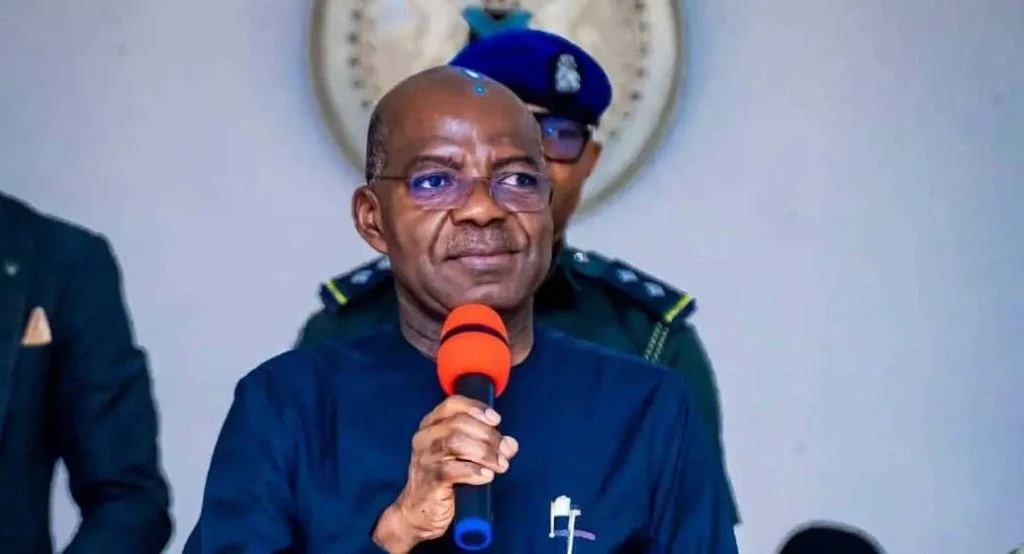
At a monthly media chat tagged “Alex Otti Speaks to Abians,” the governor laid out a timeline that would make Abia the first state in Nigeria to achieve full energy independence.
The centerpiece is Geometric Power, Aba, which currently operates three turbines generating 141 megawatts. The state is now acquiring a fourth turbine—a 125-megawatt General Electric gas turbine located in the Netherlands—that would boost total capacity to 266 megawatts.
That is enough, Otti said, to power not just the Aba ring-fence—eight local governments already detached from the national grid—but also Umuahia and its environs, with excess power available for sale.
“If we are able to generate enough power from the existing independent power company, we don’t need to build one in Umuahia,” he said.
The ABSU Precedent
The same day, Otti restored power to Abia State University, Uturu, after 13 years of darkness, commissioning a 5-megawatt substation. But that is just a stopgap.
The governor announced that a 15-megawatt independent power project, powered by gas turbines, is already in the works. “By the time it’s done, Abia State University may decide to detach from the national grid,” he said.
For a university that has spent over a decade without reliable public power, the prospect of independence is revolutionary. For the state, it is a proof of concept.
The Economics
Otti made one thing clear: the government will not subsidize electricity when Abia begins generating its own power.
“Consumers would discover that it would be cheaper to have 24-hour power supply,” he said.
The logic is simple: businesses currently spend fortunes on diesel generators to keep operations running during grid collapses. The cost of that fuel—and the wear on equipment—exceeds what they would pay for reliable, round-the-clock power from Geometric. If the math holds, the market will follow.
But that is a big “if.” The state will need to negotiate tariffs, build transmission infrastructure, and convince consumers that the new system is reliable enough to abandon their generators. None of that is guaranteed.
The Grid That Keeps Collapsing
Abia’s push for independence comes against the backdrop of a national grid that has become a symbol of Nigerian dysfunction.
Since the start of 2026, the grid has collapsed multiple times, plunging vast swathes of the country into darkness. The January 2026 collapse alone affected 17 states. Aba, already on the geometric ring fence, was reportedly unaffected.
That is the selling point: independence from a system that has failed Nigerians for decades. But independence also means isolation. If Geometric’s turbines fail, there is no backup. If the gas supply is interrupted, there is no fallback. The same vulnerabilities that plague the national grid—pipeline vandalism, gas supply disputes, foreign exchange shortages for maintenance—will also plague Abia’s independent system.
The Challenges Ahead
The plan is ambitious, but the path is littered with obstacles.
Acquisition and installation: The 125-megawatt turbine is in the Netherlands. Getting it to Abia, installing it, and integrating it with the existing system is a logistical and financial challenge. The governor did not disclose the cost.
Gas supply: Geometric Power’s gas pipeline runs from Rivers State to Aba. That pipeline has been targeted by vandals before. Ensuring an uninterrupted supply will require security arrangements that go beyond what the state can provide alone.
Transmission and distribution: Extending power from Aba to Umuahia requires new infrastructure. The state must build or acquire the lines, substations, and distribution networks to deliver electricity to areas that have never received a reliable supply.
Tariff and affordability: Otti has ruled out a subsidy, but can consumers afford market-rate electricity? Aba’s industrialists, who form the backbone of Geometric’s customer base, have deep pockets. Residential consumers in Umuahia do not. If the tariff is too high, people will stay on generators—and the independent system will not generate enough revenue to sustain itself.
Regulatory hurdles: The Nigerian Electricity Regulatory Commission (NERC) oversees the power sector. While the state can generate and distribute within its territory, it must still operate within the national regulatory framework. Navigating that bureaucracy will test the state’s resolve.
What Success Would Mean
If Abia succeeds, it would be a watershed moment for Nigeria’s power sector.
It would prove that states can take control of their own electricity supply—that the grid is not a necessity, but a choice. It would pressure other states to follow suit, creating a patchwork of independent power systems that could, over time, make the national grid obsolete.
It would also expose the bankruptcy of the current model. For decades, the federal government has presided over a sector that consumes billions of naira in subsidies while delivering unreliable power. A state going it alone would be an indictment of that failure.
What Failure Would Mean
But if Abia fails—if the turbines do not arrive, or the gas stops flowing, or the tariff proves unaffordable—the consequences would be severe.
The state would be left with a massive infrastructure investment that cannot sustain itself. Consumers who abandoned generators would scramble back to them. And the dream of energy independence would become a cautionary tale, cited by critics who argued that states cannot solve problems the federal government could not.
The Bigger Question
Governor Otti’s gamble raises a question that extends far beyond Abia: can Nigerian states truly govern themselves, or are they permanently dependent on a dysfunctional center?
The power sector is a test case. If Abia can deliver reliable electricity while the national grid continues to collapse, it will be proof that federalism—real federalism—can work. If it cannot, the argument for central control will seem vindicated.
Otti is betting on the former. “We don’t need to build one in Umuahia,” he said, referring to a separate independent power project. “If we are able to generate enough power from the existing independent power company, we don’t need to build one.”
The turbine is in the Netherlands. The gas is in the pipeline. The political will is in the Government House. And the rest of Nigeria is waiting to see whether a single state can do what the entire country has failed to do for decades: keep the lights on.
Will Abia succeed where the federal government has failed? Or will the obstacles that have crippled the national grid prove just as insurmountable at the state level?
The answer will determine not just Abia’s energy future, but the future of Nigerian federalism itself.