Treasure Thoreson, a special education teacher in Minneapolis, was drinking coffee in her pajamas when she heard a knock at her front door.
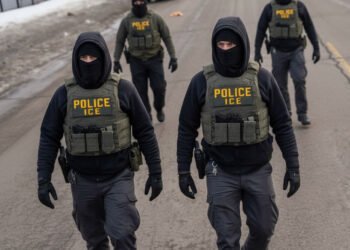
“I go, and I see a woman standing there in office clothes, but with a Homeland Security vest over the top. And I see six more agents standing in my front yard,” Thoreson told NPR. “She said, ‘We have a warrant for your arrest, for conspiracy.'”
Thoreson is one of more than three dozen people charged with conspiracy to impede or injure a federal officer since President Trump took office last year. The Justice Department has filed at least 10 cases, all involving people protesting federal immigration enforcement.
The statute, which dates back to the Civil War, has historically been used infrequently. Before 2025, most recent cases using the conspiracy-to-impede statute stemmed from the Jan. 6 insurrection and involved far-right groups like the Proud Boys and the Oath Keepers. Those cases were either dismissed or pardoned when Trump took office.
How the Cases Are Playing Out
The government charged Thoreson and 14 others with engaging in a conspiracy to impede federal agents — a conspiracy it says culminated in the use of blockades outside the Whipple Federal Building, which served as ICE’s headquarters during the immigration enforcement surge in Minnesota this past winter.
The government cited meetings and conversations on the encrypted messaging app Signal as evidence. At the advice of her lawyer, Thoreson declined to comment on the specifics of the indictment.
Many of the conspiracy cases against ICE protesters have been dismissed or are ongoing, but the Justice Department is having some success. In Spokane, Washington, three defendants were found guilty of conspiracy after a protest outside a building where federal immigration officers were holding two immigrants.
Legal Concerns
The rise in conspiracy charges has caused some legal experts to worry that the federal government is stretching the bounds of the law to sweep up political activists who oppose the Trump administration’s deportation agenda.
“Aaron Terr, director of public advocacy at the Foundation for Individual Rights and Expression, stressed that each of the conspiracy cases is different. Some involve property destruction or even violence, which the First Amendment does not protect. The case in Texas, for instance, involved a protester shooting a local police officer, who survived.”
“The government can legitimately prosecute people for that. But some defendants aren’t accused of personally engaging in that conduct,” Terr says. “The concern there is that the government may be casting too wide a net. It may be lumping in innocent people or people who committed minor misdemeanors, based on their political beliefs.”
A Civil War-Era Law
The conspiracy-to-impede statute can carry a sentence of up to six years in federal prison. For a conspiracy to occur, Terr says there has to be an agreement among people to commit a crime and, according to the statute, that crime has to prevent the officer from doing their duties through force, intimidation, or threat.
“If someone shows up to a protest and they’re prepared to engage in civil disobedience or they spontaneously decide, I’m going to join this line of people who’s blocking this detainee transport, I don’t think that’s enough to show a criminal conspiracy,” Terr says.
In a statement, the Justice Department told NPR that federal prosecutors are correct to prioritize these cases. “People should not mistake violence against law enforcement or impeding officers performing their duties with peaceful protest,” the statement said.
The Prosecutorial Push
The day after a protest in Spokane, the DOJ ordered U.S. attorneys around the country to prioritize prosecuting protesters who destroyed property or assaulted law enforcement, according to an internal email seen by Reuters. A few months later, then-Attorney General Pam Bondi issued a memo directing U.S. Attorneys in select districts to charge those protesters “with the highest provable offense available under the law.”
The Spokane case saw the acting U.S. attorney resign rather than sign the indictment. His successor signed it. Six defendants pleaded guilty, but three went to trial. All three were found guilty.
The Defendants’ Stories
Jac Archer, a longtime organizer, and Bajun Mavalwalla II, a combat veteran who served in Afghanistan, were among those convicted. Mavalwalla told NPR: “Being charged with a federal felony, a conspiracy charge that holds the potential for six years in prison because I showed up to a protest, seems to me to be an attack on a fundamental right that all Americans hold.”
In Chicago, Joselyn Walsh and Michael Rabbitt were charged with conspiracy after a protest outside an ICE facility. Both say they touched a vehicle briefly but did not damage it. The case against them was dismissed because of alleged prosecutorial misconduct.
The Bigger Picture
Katie Schwartzmann, legal counsel with the organization Protects Democracy, says more indictments against protesters could be coming.
“It’s important to see these indictments and the use of this law for what it is, which is an attempt to scare Americans,” Schwartzmann says. “But also, Americans should not be afraid to organize peaceful resistance in this moment. Those acts of ordinary people organizing and working together have been the most important force for justice in the history of our country.”
The Bottom Line
The Justice Department has charged more than three dozen people with conspiracy to impede federal officers since President Trump took office, all involving protests against ICE. The Civil War-era statute has been used increasingly to prosecute political activists. Critics worry the government is stretching the law to sweep up peaceful protesters. Some cases have resulted in convictions, while others have been dismissed. The Justice Department says it is properly prioritizing cases involving violence or obstruction of law enforcement.