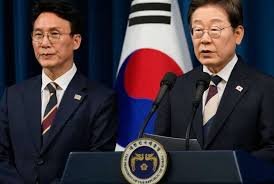

A landmark investment and security deal between President Trump and South Korean President Lee Jae Myung was supposed to open a “new chapter” in their nations’ seven-decade alliance. Six months later, that bonhomie has turned into gridlock.
The unlikely culprit? Coupang, often called the “Amazon of South Korea,” and its Korean American founder, Bom Kim.
What began as a data breach investigation has spiraled into a full-blown diplomatic crisis, pitting Washington against Seoul, triggering congressional subpoenas, and even stalling sensitive talks on nuclear submarines. At its core is a simple, explosive question: Is South Korea unfairly targeting an American company—or is a U.S. corporation using political muscle to evade accountability for a scandal that exposed 33 million people?.
The Breach, the Cover-Up, and the Fallout
The trouble began with a data breach at Coupang. South Korean regulators confirmed that the personal information of over 33 million customers—names, delivery addresses, and purchase histories—was exposed. The scale of the breach is staggering, affecting nearly two-thirds of the country’s population.
Coupang disputes this. The company, incorporated in Delaware and listed on the New York Stock Exchange, claims the perpetrator only retained data from about 3,000 accounts. South Korea’s Science Minister accused the company of acting with “extremely malicious intent” by releasing its own self-investigation results without consulting the government.
As public outrage grew, Coupang’s founder, Bom Kim, refused to appear before a South Korean parliamentary hearing, citing “pre-existing plans”. Lawmakers viewed the absence as dismissive. A person familiar with the situation told the Financial Times that advisers urged Kim to “go to Korea and apologise, apologise, apologise”—a gesture seen as a “rite of passage” for corporate leaders in the country. He did not go.
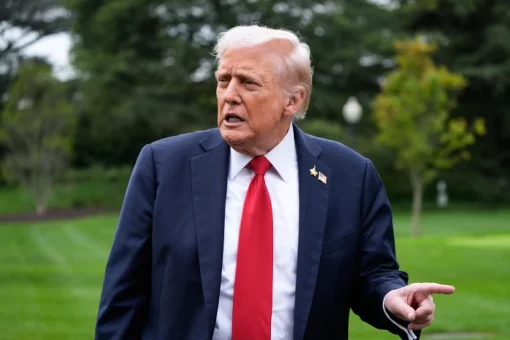
The Regulatory Escalation: A ‘Chaebol’ Showdown
The data breach opened the door to a much deeper structural confrontation. South Korea’s Fair Trade Commission (FTC) designated Bom Kim as the legal head of Coupang, placing the U.S.-listed e-commerce giant under the country’s full conglomerate regulatory regime for the first time.
It marks the first time in nearly four decades that the head of a U.S.-incorporated company is treated as a controlling individual behind a business entity in operation in Korea. The FTC argued that Kim’s brother exercised substantive influence over key operations, including logistics, effectively participating in management.
For Coupang, the compliance could have structural ramifications. Lee Seong-yeob, a professor at Korea University, said: “Coupang will now face chaebol-style regulations, including disclosure obligations and restrictions on self-dealing”.
Washington Strikes Back: ‘Targeted and Discriminatory’
Coupang has aggressively fought back, not just in Korean courts, but in the halls of the U.S. Congress. The company significantly expanded its U.S. lobbying spending in early 2026 to about $1.8 million, widening engagement beyond trade agencies to include the White House and National Security Council.
The strategy is working. In February, the House Judiciary Committee, led by Chairman Jim Jordan, opened a formal investigation, issuing a subpoena to Coupang for documents. Lawmakers argued that foreign regulators are subjecting U.S. firms to “punitive obligations, excessive fines, and discriminatory enforcement practices”.
Last month, 54 Republican lawmakers warned South Korea’s ambassador that the “targeted and discriminatory” treatment of Coupang threatened American economic and security interests. U.S. Vice President JD Vance has personally raised the Coupang case with South Korean Prime Minister Kim Min-seok.
Seoul Fires Back: A ‘Clear Infringement on Judicial Sovereignty’
South Korean lawmakers are furious. They see Washington defending a company that exposed the personal data of millions of their citizens while its founder refuses to face them.
More than 80 lawmakers of the ruling bloc signed a joint letter to the U.S. government, arguing that Washington’s defense of Coupang constitutes a “clear infringement on judicial sovereignty”. The letter alleged that the U.S. recently demanded Seoul guarantee the personal safety of Bom Kim, or risk a suspension of high-level bilateral consultations.
“There is a high risk this could go beyond a simple diplomatic rift to have a negative impact on South Korea’s labor rights and fair economic order,” the lawmakers said.
The Alliance at Risk: Nuclear Subs on Hold
The corporate dispute is now spilling into the most sensitive areas of the U.S.-South Korea alliance. Talks on advancing cooperation in nuclear-powered submarines—a key part of last November’s landmark security deal—have been stalled for at least two months this year.
National Security Adviser Wi Sung-lac has acknowledged that the Coupang case is affecting the “atmosphere” of Korea-U.S. consultations. The U.S. State Department recently emphasized the need to ensure fair treatment for U.S. companies and “swiftly resolve market access barriers”—language widely interpreted as targeting the Coupang dispute.
However, former U.S. State Department official Henry Haggard expressed confidence that the alliance itself is not being undermined, describing commercial disputes as “growing pains.” “It’s not just about the security relationship, it’s also this technological relationship. We have to find a way to manage Korea’s regulatory evolution,” he said.
The Bottom Line
Coupang, often called the “Amazon of South Korea,” is at the center of a growing diplomatic firestorm between Seoul and Washington. A data breach affecting 33 million customers led to regulatory scrutiny and a decision to designate founder Bom Kim as the legal head of a conglomerate—applying chaebol-style rules to a U.S.-incorporated firm. Coupang has lobbied Washington aggressively, leading the House Judiciary Committee to open an investigation and 54 Republican lawmakers to warn South Korea of consequences. South Korean lawmakers have fired back, accusing the U.S. of infringing on judicial sovereignty.
Sensitive security talks on nuclear-powered submarines have stalled. The alliance is being tested. And at the center of it all is a company incorporated in Delaware, listed on the New York Stock Exchange, generating 90% of its revenue in South Korea—and refusing to apologize.