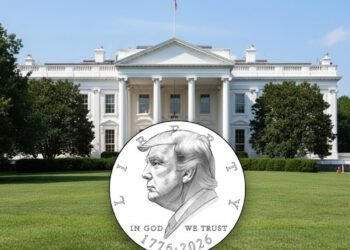

The release of the 2026 President Donald J. Trump $1 coin by the U.S. Mint immediately caused online debate over several unusual features on the currency. Celebrating the 250th anniversary of American independence (the Semiquincentennial), the new piece entered circulation alongside special collector rolls. However, key details of Trump’s new dollar coin have raised major questions regarding legal standards, pricing models, and symbolic imagery.
1. The “1776–2026” Inscription
The obverse side of the coin displays a portrait of Donald Trump flanked by the dates “1776–2026”. Critics on social media were quick to point out that formatting a historical year alongside the present year typically signifies a lifespan on a headstone. The design choice led observers to joke that the inscription reads like an obituary for American freedom, marking the exact 250-year span from the birth of liberty to its potential demise.
2. Selling $1 Currency at a Massive Premium
Despite having a nominal face value of $1, consumers cannot buy individual coins at face value from the U.S. Mint’s catalog. The minimum option is a 25-coin roll sold for $61 (roughly $2.44 per coin), while a 100-coin bag costs $154.50. Paying nearly $155 to acquire $100 worth of legal tender raised eyebrows, yet collector demand caused initial stocks to sell out online within hours of launch.
3. Depicting a Living Person on U.S. Money
Federal law under 31 U.S. Code § 5112 generally prohibits featuring any living person on American coins or paper currency, a tradition meant to keep the republic distinct from monarchies that print sitting rulers on money. Legal experts noted that while the Presidential $1 Coin Act requires a president to be deceased for at least two years before appearing on a coin, the administration cited the Circulating Collectible Coin Redesign Act of 2020 to bypass traditional restrictions for the 250th anniversary series. The only other sitting president featured on a U.S. coin was Calvin Coolidge during the 1926 Sesquicentennial.
Opinion
Examining Trump’s new dollar coin details reveals how blurred the line between public civic celebration and personal branding has become. Historically, American currency has focused on founding figures long after their passing, reinforcing the idea that the nation’s currency belongs to its citizens rather than any current leader. Placing a sitting president’s face on money breaks with centuries of democratic norms designed specifically to reject royal traditions.
Charging a 50% markup to purchase everyday circulating money directly from the government adds an ironic twist. While coin collectors routinely pay premiums for uncirculated sets, selling standard $1 coins at inflated prices transforms legal tender into a monetized political souvenir. When public institutions adapt traditional rules to highlight a current head of state, it inevitably prompts questions about institutional independence and how national identity is represented on everyday currency.