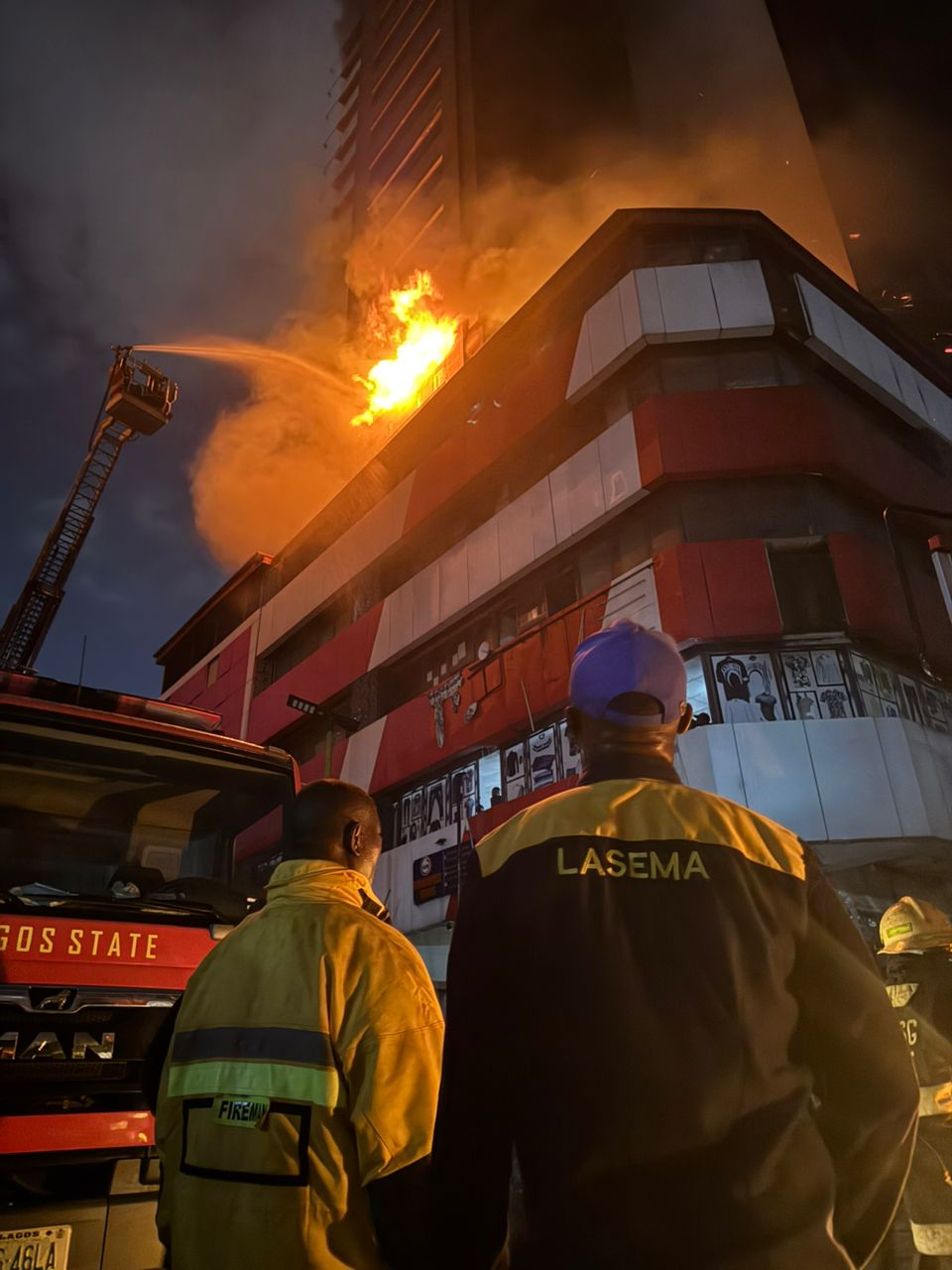
For the hundreds of traders of Balogun Market, the festive season ended in a double tragedy: a devastating Christmas Eve fire that claimed eight lives, and a subsequent government lockdown that has now strangled their livelihoods for weeks, leading to accusations of official indifference and an unfolding humanitarian crisis in the heart of Africa’s largest megacity.
The inferno at the 25-storey Great Nigeria Insurance (GNI) building on December 24, 2025, did more than destroy property; it killed three members of the same family—Stephen, Casmir, and Collins Omatu—and left portions of the structure still smoldering. In response, the Lagos State Government sealed off hundreds of shops and barricaded access roads across the bustling business district, citing an imminent risk of catastrophic collapse.
“I Can Barely Provide for My Children”: A Trader’s Laments
For traders who rely on daily sales, the prolonged closure is an economic death sentence. “My shop has been closed since December 25. I can barely provide for my children,” lamented Martin Amalos, a children’s clothing dealer. “The fire struck during the peak of my business, and I have spent all I had to survive.”
The sentiment of abandonment is universal among the stranded merchants. Oduloye Bimpe criticized the state for acting without a safety net. “Our shops were sealed without consideration for our livelihoods. There should have been assistance before the closures. Where do we go from here?” she asked, demanding the immediate demolition of the ruined building.
The Government’s Response
The government’s response has been a stark, uncompromising prioritization of safety over commerce. Lagos State Commissioner for Information, Gbenga Omotosho, defended the closures, stating the unstable high-rise “could endanger everyone within a 100-metre radius.”
“We hope people will prioritise life over livelihood,” Omotosho stated, revealing the grim human cost of the blaze extended beyond the confirmed dead. “There are reports of people who entered the building to retrieve goods during the fire and never returned.”
He dismissed the traders’ complaints about the two-week shutdown as premature, emphasizing that over ten buildings were affected and that public safety was the government’s sole, non-negotiable focus.
Why It Matters
For traders like Maduabuchukwu Ifeakomili, the abstract government calculus offers no solace. “We rely on daily income to feed our families. Some of us are borrowing money just to eat,” he said, issuing a desperate plea to Governor Babajide Sanwo-Olu to expedite demolition and “reopen the sealed sections before Saturday.”
The standoff at Balogun Market is a microcosm of a perennial Lagos conflict: the crushing imperative of survival against the brittle infrastructure of a super-city. For the government, it is a matter of preventing another, far greater disaster. For the traders, it is a slow-motion economic collapse, where the threat of a falling building is matched only by the certainty of empty stomachs and unpaid school fees.