

The news that Valentino Clemente Ludovico Garavani passed away yesterday, January 19, in his beloved Rome, at the age of 93, feels more like the sinking of a continent. In the fast-paced, digital-first landscape of 2026, Valentino was the final, towering bridge to the mid-century ‘Golden Age’ of Alta Moda, and now, losing him feels like losing the primary architect of what we once understood as ‘International Glamour.’
The Architect of Aspiration
Valentino didn’t only stitch fabric together; he actually designed an entire social stratosphere. His story started in Voghera back in 1932, and by 17, he was already in Paris learning the ropes under Jean Dessès and Guy Laroche. But while Paris taught him the craft, Rome was where he truly found his kingdom. He opened his house on the Via Condotti in 1960, right as the fashion world was standing on a precipice. The stiff, formal rules of 1950s couture were giving way to the high-flying Jet Set era, and Valentino was the one who managed to catch that lightning in a bottle.

What made him a genius wasn’t that he tried to tear things down — that wasn’t his forte’; rather, he had this relentless, almost obsessive pursuit of the “ideal.” He famously said, “I know what women want. They want to be beautiful,” and he actually meant it.
In a world like ours today, where fashion is constantly chasing what’s edgy, viral, or relevant, Valentino’s refusal to apologize for pure, unadulterated beauty came across like a radical act. He was the man who dressed Jackie Kennedy for her wedding to Aristotle Onassis because he understood something the industry often forgets: a woman doesn’t just wear a dress; she inhabits a status.
The Alchemy of “Rosso Valentino”
You can’t really talk about Valentino — or pay him any kind of proper tribute — without talking about The Red. This is more than just a signature colour; it was his psychological weapon. Valentino’s whole obsession with The Red started with a trip to the opera in Barcelona when he was just a young man. He looked up at the balconies and saw women who looked like ‘baskets of flowers,’ and in that moment, he realized that red was the only colour on earth that could truly hold its own against the spotlight.
The specific Valentino Red isn’t like any scarlet colour; it’s a very deliberate, vibrant mix of 100% magenta, 100% yellow, and 10% black. Over the decades, that shade became a shorthand for pure power and passion. This shade was the colour of the Valentino Dolls — that famous fleet of models who would close his shows like a crimson wave.
In 2026, as brands are trying their hardest to stay visible in an endless sea of shifting algorithms, the sheer staying power of The Red is a masterclass in identity. It has proven — time and time again — that it wasn’t just a marketing ploy; it was a promise. A promise that whoever wore it would never, ever be ignored.
The Business of Beauty: The Giammetti Factor
To write about Valentino is to write about one of the most successful partnerships fashion has ever seen. While Valentino was obsessing over the perfect drape of a chiffon sleeve, Giancarlo Giammetti — his longtime partner in both life and business — was busy building the walls of the empire. Together, they basically wrote the blueprint for the modern luxury brand.
They figured out very early on that for a couturier to actually survive, they had to sell more than just dresses; they had to sell a lifestyle. They leaned into perfumes, accessories, and bridge lines, effectively finding a way for the rest of the world to buy a small piece of the Emperor’s dream.
It was this perfect synergy that allowed Valentino to truly live like “The Last Emperor.” It funded the villas, the yachts, and the private jets — a level of personal, unapologetic luxury that most of today’s Creative Directors can only dream about from their corporate offices.
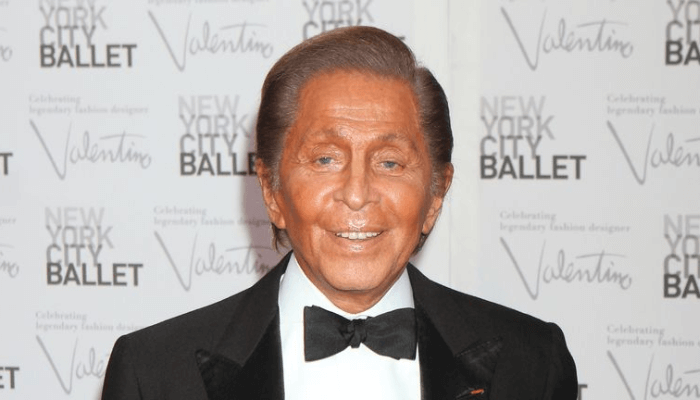
The Succession Crisis: Michele vs. The Ghost of Garavani
Now we get to the million-dollar question that’s currently rattling every front row in Paris: Who actually inherits the Roman throne?
Valentino may have retired back in 2008, but his shadow has stayed long and heavy over the Maison. For years, Pierpaolo Piccioli was the one keeping the fire lit. He managed to find this beautiful, poetic middle ground where he bridged Valentino’s old-school elitism with a modern, more inclusive humanity. But when Piccioli left in 2024, the brand didn’t just turn a page—it swapped the entire book for a different genre. Enter Alessandro Michele.
Michele is the “maximalist philosopher” who famously flipped the script at Gucci, and he’s now in the middle of a radical “re-coding” of the Valentino DNA. It’s a fascinating, if slightly jarring, collision of worlds. Where Valentino demanded absolute, porcelain-like perfection, Michele thrives in what he calls “perversity” and “clutter.” He likes the weird, the broken, and the lived-in.
If you look at his recent collections, you can see him digging through the 1970s and 80s archives like a magpie. He’s stripping away those clean, aristocratic lines and replacing them with a bohemian, intellectual eccentricity that’s very ‘Michele’ but very not ‘Garavani.’
The death of the founder yesterday changes everything for Michele. It creates this incredibly precarious moment. In the wake of this loss, there’s going to be an inevitable, nostalgic hunger for that ‘Classic Valentino’ look: the sharp shoulders, the pristine gowns, the simple elegance.
The question is: can Michele’s ‘more-is-more’ aesthetic satisfy a global audience that is suddenly, deeply mourning the loss of Roman ‘less-is-more’ sophistication?
This succession isn’t merely about who’s sitting in the studio anymore; it’s a battle for the very soul of the brand. We’re watching a tug-of-war in real-time.
Will Valentino remain a house of ‘Beauty,’ or will it transform into a house of ‘Character’? The Emperor’s throne is officially empty, and while Michele is sitting in it, he’s wearing a very different crown.
An Era Concluded
Valentino Garavani’s passing doesn’t just mark the end of a career; it marks the definitive end of a specific kind of discipline. He was a man who truly, deeply believed in the ceremony of dressing. He had no patience for ‘ugly,’ and he famously detested ‘casual.’ As we look at the future of the Maison now, we’re looking at a fashion industry that feels increasingly fractured, messy, and fast-paced.
Valentino was a constant reminder that fashion could — and should — be a sanctuary of excellence. He was perhaps the last designer to actually live the life he was selling to his clients.
As the lights finally go down on the Villa Madama, the industry is very aware that it lost more than just a legendary designer; it also lost its North Star of glamour. The Emperor may be gone, but there is a silver lining: as long as a woman steps into a room wearing that specific, defiant shade of red, his empire remains unconquered