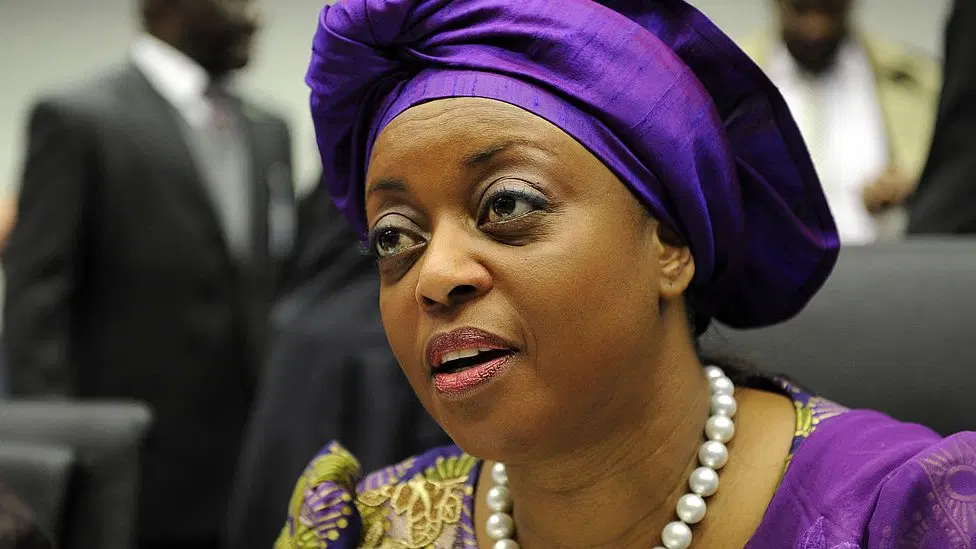
Diezani Alison-Madueke, a former Nigerian petroleum minister cleared of bribery allegations, has said UK authorities damaged her reputation through a failed prosecution she described as “painful and traumatic.”
She added that the 13-year investigation by the National Crime Agency (NCA) “could have been handled a lot differently.”
In an exclusive interview with the BBC, Diezani Alison-Madueke said: “I’ve not been allowed to travel. I’ve not been allowed to work. They destroyed my reputation and my integrity.”
The 65-year-old served as Nigeria’s petroleum minister between 2010 and 2015, and also became the first woman to serve as president of OPEC, the organisation of oil-exporting countries.
“When your freedom is taken away from you…it has a very deep impact upon you psychologically,” she said.
“I knew that I had never done anything nefarious and I had never done any of the heinous things I was being accused of doing.”
First arrested in 2015 and not formally charged until 2023, Alison-Madueke was accused of receiving illegal payments from wealthy oil executives awarded government contracts, who allegedly funded what prosecutors described as “a life of luxury.”
Among the alleged benefits were luxury goods valued at around £2 million ($2.65 million) from Harrods, along with chauffeur-driven cars and access to high-end properties in London and Buckinghamshire.
However, from the beginning of the trial in January, defence lawyers challenged the fairness of the prosecution, claiming that key documents supporting Alison-Madueke’s defence had been lost in Nigeria.
She said the missing materials included boxes of receipts indicating that the oil executives had been repaid for expenses they covered on her behalf.
She said: “Those items were taken away by our intelligence forces” from her Abuja residence in 2015, adding that she does not know what eventually became of them.
Formerly appointed by then-President Goodluck Jonathan, Alison-Madueke was supported in court by a written statement in which he said it was common practice for third parties to pay for ministers’ transport and accommodation during official overseas trips.
Asked who she holds responsible for the failings in the case against her, Alison-Madueke said: “There’s a bit of blame everywhere.”
“The Nigerian authorities need to look into the processes and practices that they deploy in these cases.”Regarding the National Crime Agency (NCA), she said: “The long arm of the law when you go into other countries, particularly in politically motivated cases, needs to have a lot more sensitivity.”
She said she believes she was targeted by the agency as “low-hanging fruit,” arguing that investigators overlooked her efforts to fight corruption in the oil sector and the powerful adversaries she had made in Nigeria, Africa’s biggest oil producer.
“I was the first female to enter this sort of position as petroleum minister and as head of Opec in a very misogynistic society.”
The NCA should have “taken a step back and looked with a little more depth at the truth of the situation on the ground,” she said.An NCA spokesperson told the BBC that the agency “conducted a long-running, in-depth and complex investigation which was regularly reviewed throughout its duration by the CPS [Crown Prosecution Service] and investigators.”
The spokesperson also said the NCA “worked closely with international partners and, as in all cases, this investigation was carried out with impartiality.”
“A comprehensive file of evidence was presented to the CPS who authorised charges and we respect the decision of the jury in court.”
Doye Agamas, 69, the elder brother of Alison-Madueke and an archbishop in a Pentecostal church in Manchester, was also acquitted of conspiracy to commit bribery.
Olatimbo Ayinde, 54, an oil industry executive, was also cleared of bribery and bribery of a foreign public official. She had been prosecuted even though she was acting as an informant in an anti-corruption probe conducted by Nigerian authorities.
In 2023, the US Department of Justice recovered assets valued at $53 million (£40 million) that had been confiscated from two oil businessmen linked to the case.
At the time, a spokesperson for the department said that “Alison-Madueke used her influence to steer lucrative oil contracts” to companies owned by the individuals involved.
Addressing the allegation, Alison-Madueke told the BBC that she was never able to defend herself in court because she was not formally charged, insisting that the contracts were handled through “the exact due process that they are supposed to go through.”
In 2022, Nigeria’s Economic and Financial Crimes Commission (EFCC) said it recovered about $153 million and more than 80 properties linked to the politician.
When asked about the issue, she responded: “The assets that have been forfeited were not actually traced directly to me… I don’t know what has happened to these matters at all. It’s now that I’ll have the freedom to find out what exactly has gone on there.”