

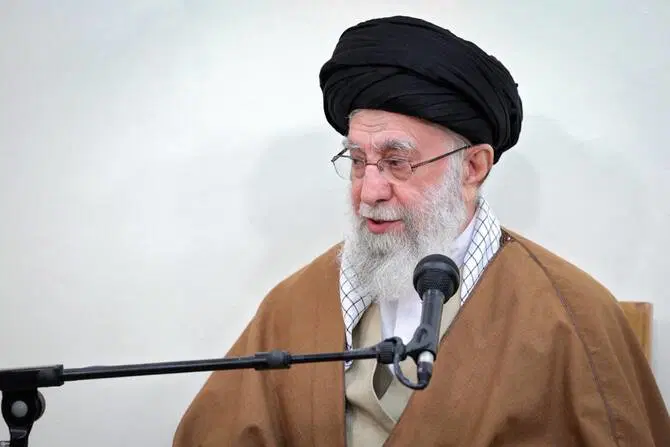
Five days after Ayatollah Ali Khamenei was killed in the opening wave of U.S.-Israeli strikes, Iran still cannot bury its supreme leader.
The state funeral for the 86-year-old cleric, set to begin Wednesday night at Tehran’s Grand Mosalla prayer complex, has been indefinitely postponed, authorities announced — an unprecedented delay in the Islamic Republic’s history.
The official reason: too many mourners.
Seyyed Mohsen Mahmoudi, head of the Islamic Propaganda Co-ordination Council of Tehran province, told the hardline Tasnim news agency that the ceremony was postponed due to “the high volume of requests to attend this ceremony and the need to provide appropriate facilities to host the people.”
The real reason is less ceremonial: U.S. and Israeli bombs continue to fall across Tehran.
The War Rages
Since Saturday, when the U.S.-led coalition launched “Operation Epic Fury” against Iran, more than 100 Israeli fighter jets have dropped roughly 250 munitions on military targets in eastern Tehran alone, according to the Israel Defense Forces. Ballistic missile arrays, air defense systems, missile production facilities, and detection systems at Mehrabad airport have been systematically destroyed.
The IDF announced Wednesday that an Israeli F-35 fighter jet shot down an Iranian Yak-130 over Tehran — “the first shootdown in history of a manned fighter aircraft by an F-35”.
Iran’s state news agency Irna reported that U.S. and Israeli strikes have killed 1,045 military personnel and civilians since the conflict began. The U.S.-based Human Rights Activists News Agency put civilian deaths alone at 1,097, including 181 children under 10.
Among the dead: an 11-year-old girl in Kuwait, killed by falling shrapnel during an Iranian missile attack. Nine others have died in Kuwait since the conflict started — six U.S. service personnel, two Kuwaiti army soldiers, and one other civilian.
The Succession Crisis
With Khamenei unburied and the nation at war, Iran’s clerical leadership is racing to choose a successor.
Ayatollah Ahmad Khatami, a member of the Assembly of Experts — the 88-member body responsible for selecting the next supreme leader — told state TV that candidates had been identified and a decision was imminent.
“The supreme leader will be identified in the closest opportunity, we are close to a conclusion,” he said. “However, the situation in the country is a war situation.”
Two Iranian sources told Reuters that Mojtaba Khamenei, the late leader’s 56-year-old son, is considered the front-runner. A shadowy cleric said to have amassed significant power and wealth under his father’s rule, Mojtaba is close to conservatives and the Islamic Revolutionary Guard Corps.
Israel’s defense minister issued a stark warning: any successor who continues to threaten Israel and the U.S. would be “an unequivocal target for elimination”.
The Naval Battle
While the aerial campaign dominates headlines, the war at sea has claimed its first major victim.
U.S. Defense Secretary Pete Hegseth announced that a U.S. submarine sank an Iranian navy frigate in the Indian Ocean off the coast of Sri Lanka.
“[The warship] thought it was safe in international waters. Instead, it was sunk by a torpedo. Quiet death,” Hegseth told reporters.
Sri Lanka’s Defense Secretary Air Vice Marshal Sampath Thuyyakontha said the bodies of 80 people aboard the Iris Dena had been recovered. Another 32 were rescued; dozens remain missing.
‘A Fair Fight’?
Hegseth was unapologetic about the campaign’s intensity.
“This was never meant to be a fair fight, and it is not a fair fight,” he declared. “We are punching them while they’re down.”
He predicted total U.S.-Israeli aerial superiority over Iran within days and said coalition forces would “soon” control the country.
U.S. Central Command head Adm. Brad Cooper said the campaign was “ahead of our game plan.” “In simple terms, we’re focused on shooting things that can shoot us,” he added.
The Regional Fallout
Iran has responded by launching hundreds of missiles and drones at Israel and neighboring Gulf states hosting U.S. military installations.
Qatar’s prime minister, Sheikh Mohammed bin Abdul Rahman Al Thani, told Iranian Foreign Minister Abbas Araghchi in a phone call that Iran was seeking to harm its neighbors and draw them into a war “that is not theirs”. He “categorically rejected” Araghchi’s assertion that missiles were directed solely at U.S. interests, citing strikes on civilian infrastructure and residential areas.
Qatar’s State Security Service announced the arrest of 10 members of two cells allegedly linked to the IRGC, tasked with spying on infrastructure and carrying out “sabotage operations”.
In Saudi Arabia, authorities reported an attempted drone attack on the Ras Tanura refinery, the kingdom’s largest oil facility. No damage was reported, though the refinery was forced to halt some operations on Monday after a drone strike caused a fire.
Turkey’s defense ministry said an Iranian missile heading toward its airspace was intercepted by NATO air and missile defense systems in the Eastern Mediterranean.
The Human Cost
Ten people have been killed in missile strikes in Israel over the past five days. In Iran, the toll continues to rise.
And Khamenei, the man who ruled Iran for 37 years, remains unburied — his body awaiting a funeral that cannot be held while the bombs keep falling.
“We have nowhere to go to protect ourselves from strikes, how can we protest?” one terrified Tehran resident told Reuters. “How can we attend a funeral when there is no safe place to mourn?”
The answer, for now, is that they cannot. The supreme leader is dead. His successor is not yet chosen. And the war shows no sign of ending.