

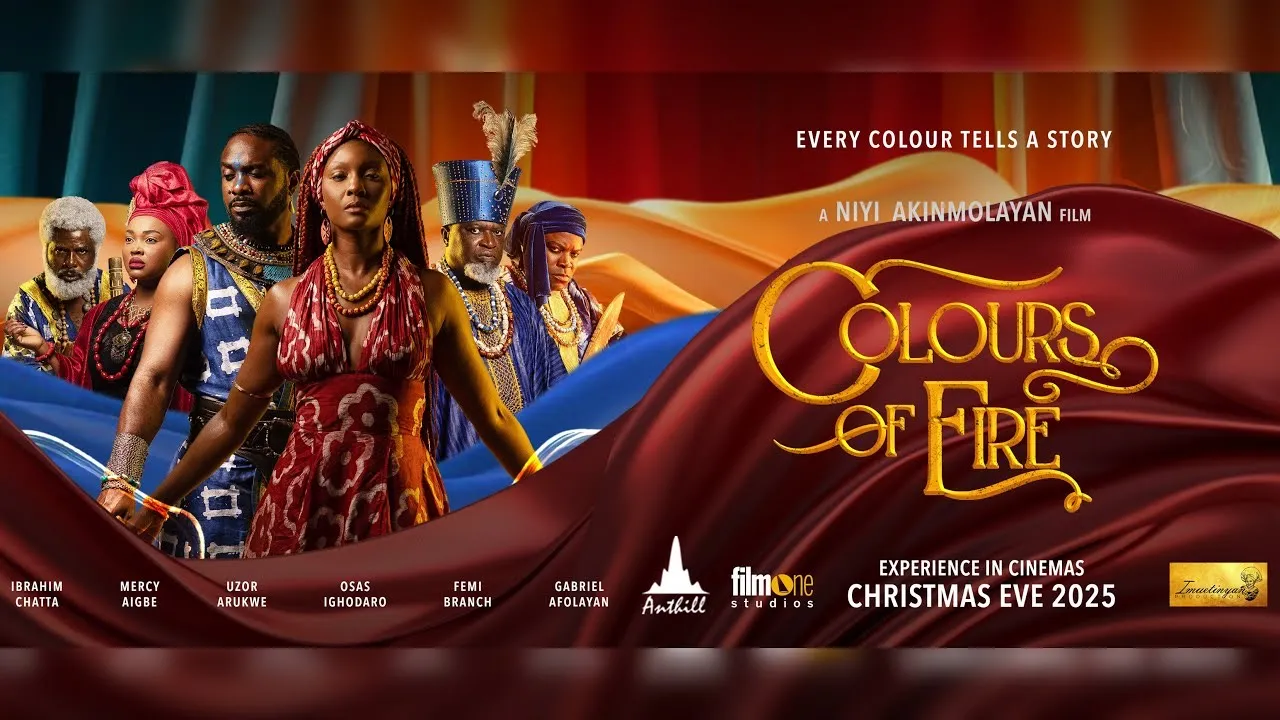
Colours of Fire arrives as one of Nollywood’s most ambitious cultural films in recent times, boldly blending folklore, romance, mysticism, and war into a richly stylised narrative. Directed by Niyi Akinmolayan, the film clearly aims high, offering stunning visuals, layered symbolism, and a reverent nod to Yoruba mythology. While it succeeds in many technical and artistic areas, one major creative decision threatens to undermine its cultural authenticity—and that choice could have lasting implications for Yoruba storytelling in cinema.
Story and Themes: Love, Loyalty, and Hidden Truths
At the heart of Colours of Fire is a tale of duty versus desire. The story follows a warrior sent on a dangerous mission to hunt a mysterious beast believed to have been unleashed by a rival clan. What begins as a straightforward quest soon unfolds into something far more complex, revealing secrets, ancient rivalries, and a forbidden bond that could either unite two worlds or destroy them entirely.
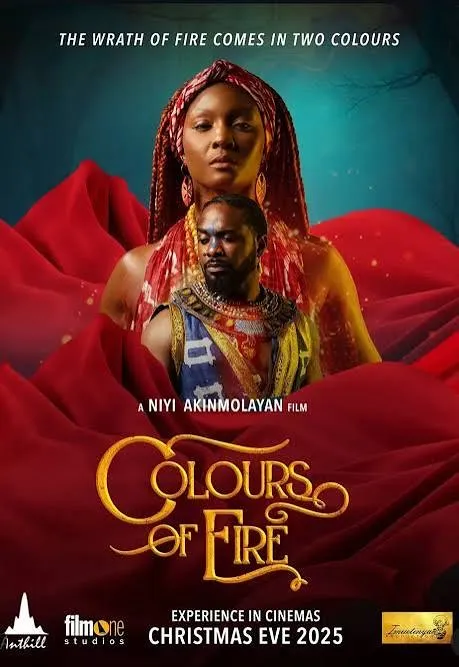
The film thrives on drama, layered storytelling, and symbolic exchanges. Rather than relying on explicit dialogue, it cleverly employs Yoruba proverbs and metaphors to veil conversations that might otherwise appear provocative. In one memorable instance, a suggestive exchange is cloaked in references to a cutlass, subtle enough to pass over the heads of younger viewers while remaining clear to adults. This thoughtful use of folklore-driven communication adds depth and intelligence to the screenplay.
Cultural Representation: Folklore Meets Interpretation
Colours of Fire draws heavily from Yoruba culture and mythology, weaving familiar historical and folkloric figures into its narrative. Characters inspired by legends such as Moremi and Efunsetan are reimagined with creative liberty, giving the film dramatic weight and mythic appeal. However, this reinterpretation raises concerns about historical distortion, particularly for viewers who regard these figures as sacred cultural symbols rather than fictional constructs.
While artistic licence is expected in cinema, the film walks a thin line between creative expression and cultural revisionism—a choice that may not sit well with purists.
Costumes, Production Design, and Visual Style
One area where Colours of Fire truly shines is its costume design. The extensive use of Yoruba Adire fabrics is breathtaking, with vibrant colours dominating the screen and enhancing the film’s emotional tone. The resurgence of Adire in contemporary Nigerian fashion is smartly leveraged, making every scene visually immersive.
The production design complements the costumes beautifully, suggesting a lavish set that likely required significant investment. Lighting choices—particularly the use of blue and orange hues—create a striking teal-and-orange aesthetic that elevates night scenes and adds cinematic polish.
However, not everything lands perfectly. While the film’s ambition is evident, the contrast levels are occasionally overwhelming, with too many bold colours competing for attention. More disappointing is the use of CGI, especially during the beast-to-human transformation scene. The effects feel underwhelming and distract from the story. A practical costume approach would have delivered a more believable and immersive result.
Standout Performances: Who Owned the Screen?
Osas Ighodaro delivers the most compelling performance as Moremi. She embodies an intoxicating blend of beauty, danger, and mysticism, portraying a character whose allure feels both divine and deadly. Her costume design, particularly her horn-shaped braids, reinforces her goddess-like presence and enhances her performance.
Gabriel Afolayan once again proves his reliability, bringing emotional depth and gravitas to his role. Uzor Arukwe also performs well, though it takes time to adjust to his character due to his frequent casting in similar roles in other films, which initially makes him feel typecast.
The Biggest Letdown: Language and Cultural Responsibility
Despite its deep immersion in Yoruba tradition, Colours of Fire makes a controversial choice by relying predominantly on English dialogue. While a few Yoruba expressions are sprinkled throughout, the language takes a backseat in a story rooted entirely in Yoruba culture.
The likely intention was to reach a broader audience, but this approach raises serious questions. Subtitles exist for a reason, and global audiences have repeatedly shown their willingness to embrace foreign languages—from Korean dramas to Latin American films deeply inspired by Yoruba traditions.
By sidelining the Yoruba language, the film risks weakening cultural preservation. History has shown how language loss can erode cultural identity, and cinema should be a tool for preservation, not dilution.
Final Verdict: Worth Watching, But With Reservations
Colours of Fire is an engaging, visually rich film that succeeds in storytelling, costume design, and thematic depth. However, its decision to prioritise English over Yoruba language undermines its cultural mission.
Is it worth watching? Yes—especially for lovers of folklore-driven drama and visual spectacle. But viewers should be prepared for moments of nudity and a lingering sense that something culturally essential was left behind.