
For his Men’s Fall-Winter 2026 show for Louis Vuitton, Pharrell Williams did something much more radical, and frankly, much more intimate. He built a house.
The Drophaus: A Solution Builder’s Manifesto
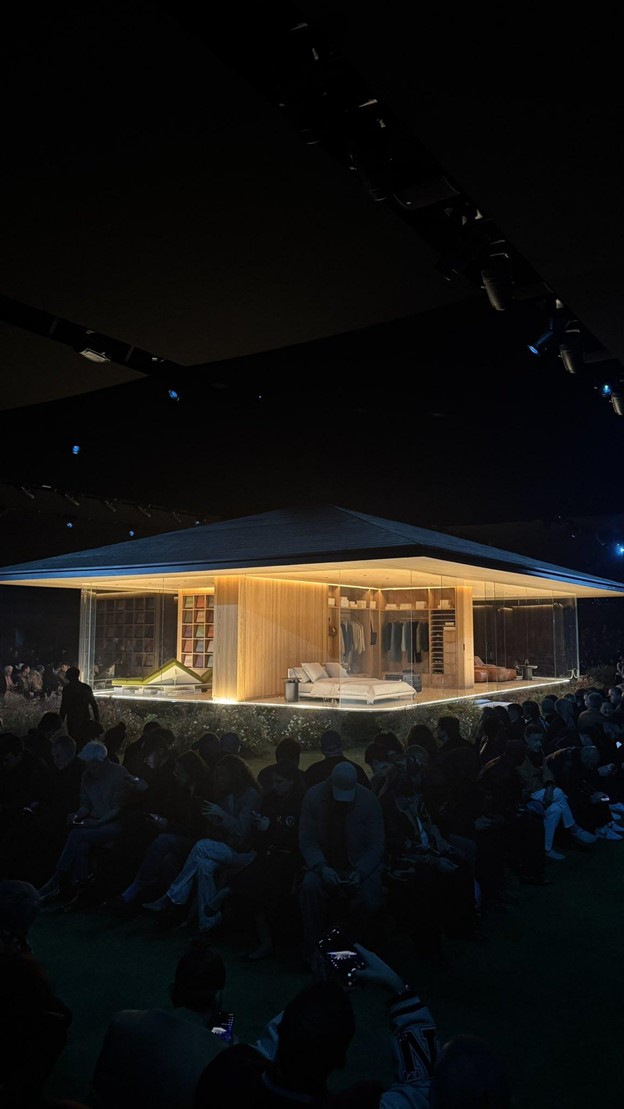
In his latest show, Pharrell didn’t opt for the grand bridges or public squares of seasons past. Instead, nestled within the Jardin d’Acclimatation, he constructed an entire “future living concept”: a sleek, glass-walled, prefabricated thing of beauty that he dubbed the DROPHAUS. Designed in collaboration with the visionary Japanese firm NOT A HOTEL, this architectural statement was directly inspired by the perfect, simple shape of a water droplet.
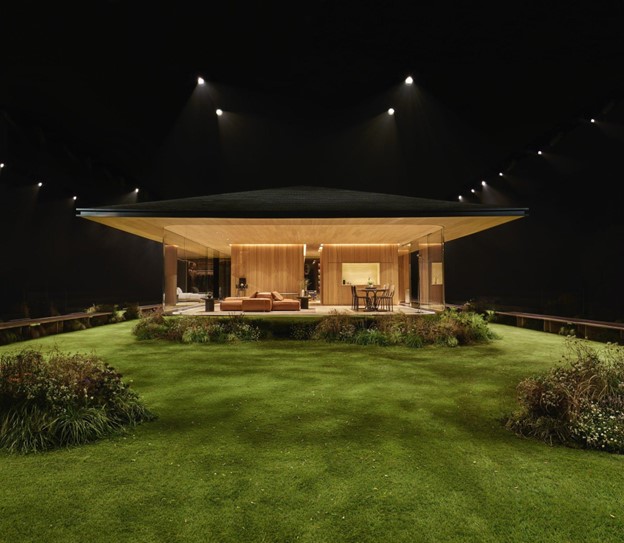
Of course, Pharrell, with his signature humility, clarified that he isn’t an architect in the traditional sense, but rather a “solution builder.” And with the Drophaus, he’s offering a keen solution to the sterile perfection often found in high design.
Inside this transparent sanctuary, he unveiled HOMEWORK, his new furniture collection. This one, however, didn’t care much for being pristine, untouchable pieces; it was rather about the embrace of human imperfection. Here, he introduced a concept that should be a wake-up call for an industry obsessed with AI-generated perfection: the “10% imperfection” rule — a philosophy that things shouldn’t be too polished, too untouched.

Pharrell argued that for a space to feel real, to feel like a home rather than a showroom, it needed to be slightly off. It needed the human touch, which meant that there had to be creases in the leather and a slight asymmetry in furniture, which can only be gotten in the privacy of your home when the door is locked, the shoes are off, and you’re at your most comfortable in your favorite couch.
Speaking of shoes, the invitations were tan leather slipper,s which, in my opinion, was a cheeky, brilliant move. It told every high-powered editor and celebrity in attendance exactly what the vibe was: “You’re at home now, so relax.”
Real Clothes for a Real World as The New “Pragmatic” Flex
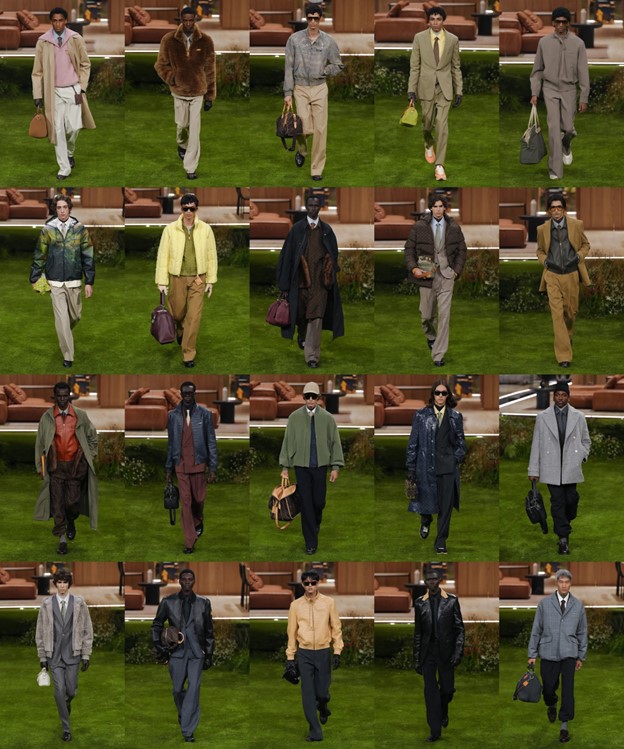
This show felt like the moment the fashion industry finally stopped shouting and started listening. We’re living in a time where extravagance for the sake of it feels a bit tired, right?
Well, Pharrell seems to get that.
He’s leaning into this idea that true luxury is a tool rather than a costume. He’s moved us past the era of “look at me” logos and into a space where the most impressive thing about your coat is how it actually works.

He’s calling this new vibe the Future Dandy, but honestly, it just looked like the coolest version of a guy who actually has somewhere to be. Gone were the weird, “is-this-even-wearable?” sci-fi experiments. Instead, we got these incredibly sharp double-breasted suits and trenches that looked like they were built to survive a storm, not just a red carpet.
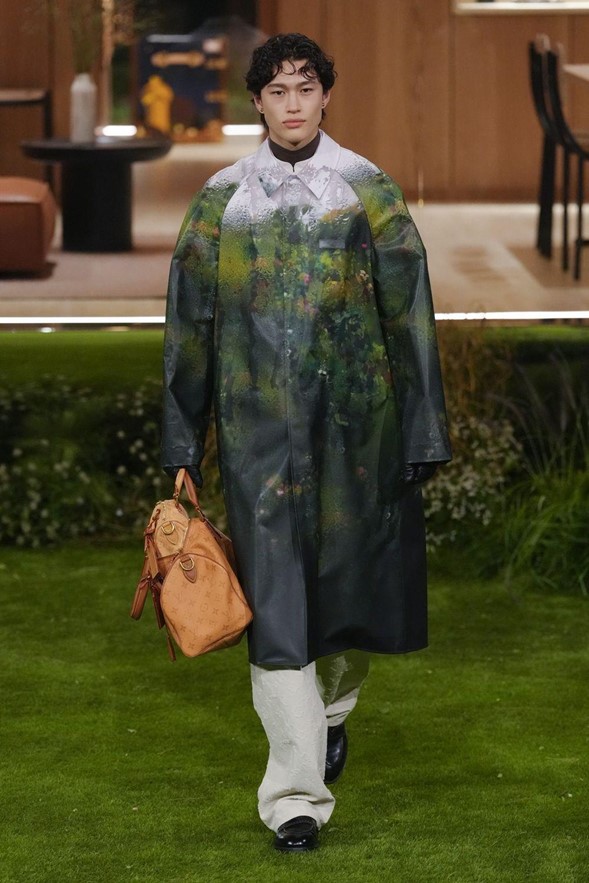
The silhouette for FW26 is grounded in earth tones: moss greens, deep clays, and a specific asphalt grey. But the real magic for me is in the textiles. We saw double-breasted suits and parkas that looked like heavy, traditional leather but were actually a high-tech silk-nylon. They’re water-repellent and light as air. It’s, quite frankly, pragmatic luxury: the idea that you can look like a million bucks while being completely prepared for a downpour.
Even the accessories felt more considered. The Speedy bag — the undisputed king of the LV archive — showed up in an understated, matte-black crocodile.
The Sound and Scent of the Drophaus

Pharrell has always been a bit of a maximalist when it comes to the senses, and this show wasn’t just something you watched—it was something you lived in for twenty minutes. Most designers treat the soundtrack as an afterthought, but Pharrell (ever the musician) literally records his in the studio at LV’s Paris headquarters, making it not some background noise but the heartbeat of the whole concept.
The runway, for its part, felt more like an exclusive listening party than a fashion show. We got world premieres of unreleased tracks from A$AP Rocky and John Legend, plus a glossy, jittery collaboration between Jackson Wang and Pusha T called “Sex God” that had the front row actually nodding along rather than just staring blankly. When the Voices of Fire choir and l’Orchestre du Pont Neuf swelled into the mix, it grounded the high-tech “Drophaus” set in something deeply soulful.
But the real question did you catch that? The moment was the air itself.
Pharrell brought in the house’s master perfumer, Jacques Cavallier Belletrud, to scent the entire venue. Instead of some heavy, overbearing cologne, the air smelled like a garden after a storm: damp pine, fresh rain, and earth. This blurred the lines between the glasshouse on the runway and the actual Jardin d’Acclimatation outside. You weren’t just looking at a Future Dandy; you were breathing in his world. It was a total immersion that made the usual frantic energy of Paris Fashion Week feel, for a moment, like home.
Fulfilling a Legacy: From Virgil to Pharrell
What Pharrell is doing at Louis Vuitton is bigger than just fashion. In many ways, Pharrell’s Drophaus felt like the profound fulfillment of a legacy. His predecessor, the late Virgil Abloh, was himself a trained architect who often dreamt of extending Louis Vuitton beyond fashion into a true “Cultural House.” Pharrell, by literally building a home on the runway, has taken that ambition and materialized it in the most tangible way possible.
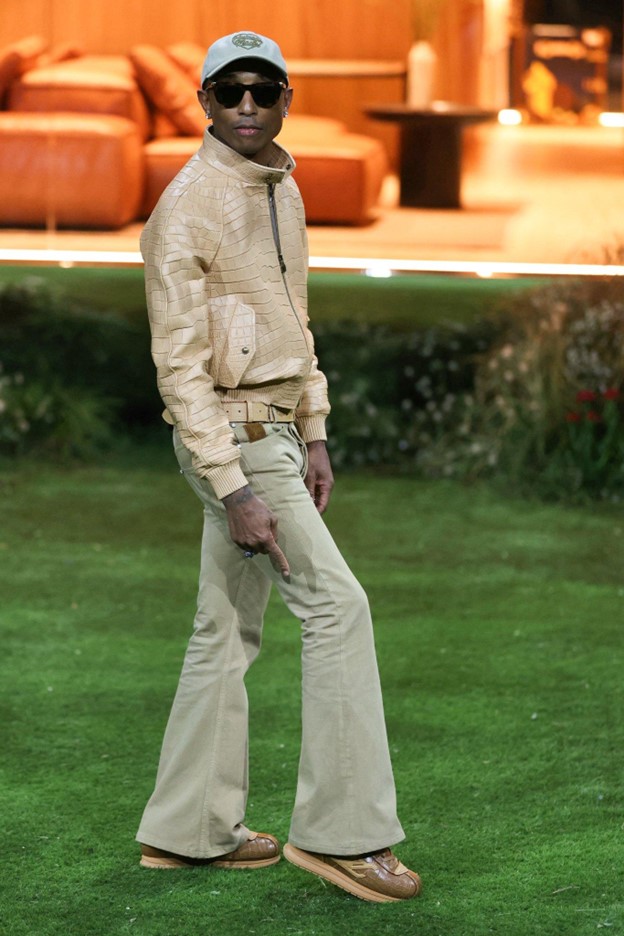
By constructing a literal home on the runway, he’s acknowledging that our lives have become more fluid. The office is the home, the home is the sanctuary, and the sanctuary is the brand.
He is moving us away from the idea of luxury as a costume we put on to impress others. Instead, he’s proposing that luxury is a curated thing. It’s the music you hear, the scent in your hallway, and the 10% imperfection of the chair you sit in.