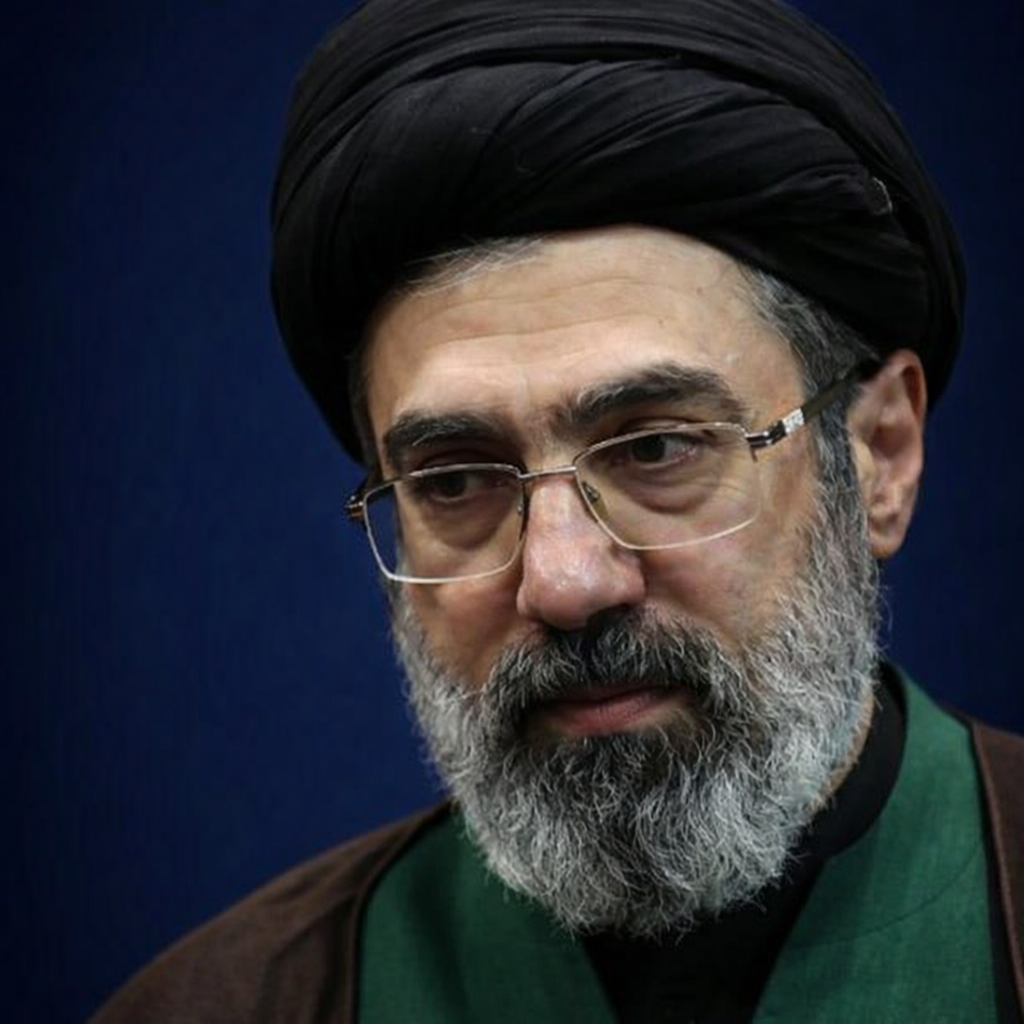
Four days after U.S. and Israeli strikes killed Iran’s supreme leader, the Islamic Revolutionary Guard Corps has moved decisively to shape the succession, pressuring the Assembly of Experts to select Ayatollah Ali Khamenei’s second son as his replacement, according to multiple sources familiar with the deliberations.
The 56-year-old Mojtaba Khamenei, a mid-ranking cleric with decades-long ties to the IRGC, emerged as the clear front-runner during two online meetings of the 88-member Assembly on Tuesday, three Iranian officials told The New York Times. The formal announcement could come as early as Wednesday, though some clerics expressed concern that naming him publicly would make him an immediate target for U.S. or Israeli strikes.
The succession process has been anything but routine. The Assembly’s planned meeting place in the holy city of Qom was bombed by Israeli forces, forcing clerics to convene online. Iran’s Fars News Agency reported the building was empty at the time, but the message was unmistakable: even the mechanism for choosing a new leader is in the crosshairs.
Why the IRGC Pushed Mojtaba
The Revolutionary Guards needed two things simultaneously: control and legitimacy, according to Iran International, which first reported the IRGC’s aggressive intervention.
Control means keeping the chain of command intact, preventing splits at the top, and maintaining security coordination while the country faces external attack. Legitimacy, in this context, doesn’t mean broad national acceptance. It means acceptance inside the regime’s core base — the hard-line politicians, security institutions, and loyal networks that still see the Islamic Republic as “their” state.
Mojtaba offers something no other candidate can claim: direct continuity with his father. For at least two decades, he has effectively run the Supreme Leader’s office, the Beit, serving as the key channel between Khamenei and IRGC command networks. He fought in the Iran-Iraq war, maintains deep relationships across the security apparatus, and has long been seen as a behind-the-scenes power broker despite holding no formal government position.
“The IRGC heavily pressured the Assembly of Experts to back Mojtaba as the regime’s new leader,” Iran International reported, citing informed sources.
Is He The Most Pragmatic Choice?
Tehran-based analyst Mehdi Rahmati offered a more clinical assessment. “Mojtaba is currently the most pragmatic choice due to his expertise in managing and coordinating security and military institutions,” Rahmati said.
But he warned the decision carries significant risk. “This is not a decision that will satisfy everyone,” Rahmati said. “Some citizens will react negatively and strongly to this decision, which could backfire”.
Pro-regime loyalists will view Mojtaba as the continuation of a martyred leader and support him without hesitation, analysts say. But opposition forces — already emboldened by the January protests that saw thousands killed in a government crackdown — will see him as the embodiment of a system they want to overthrow.
The Islamic Republic has long criticized hereditary rule, presenting itself as a more virtuous alternative to monarchies. Khamenei himself reportedly did not include his son on a list of possible successors he prepared last year. Mojtaba’s elevation under IRGC pressure threatens to expose that contradiction at the regime’s most vulnerable moment.
The Candidates Who Weren’t Chosen
Other names had been in circulation. Alireza Arafi, a senior cleric hand-picked by Khamenei for the Guardian Council in 2019, was considered a potential compromise candidate. Hassan Khomeini, the grandson of the Islamic Republic’s founder, represented a more moderate option with ties to reformist circles that have been largely marginalized.
Both were viewed by analysts as more palatable to the West — a point not lost on the IRGC, which appears to have moved decisively to prevent any deviation from the hard-line path.
Trump administration officials had privately expressed hope for a more moderate figure to emerge. On Tuesday, however, President Trump acknowledged the difficulty. “Most of the people we had in mind are dead,” he told reporters in the Oval Office.
The Succession Trap
Mojtaba now inherits an impossible dilemma. If he maintains his father’s hard line, he becomes the central node in an escalating conflict with the world’s most powerful military. Israeli Chief of Staff Eyal Zamir has already declared him a “target for elimination”.
If he chooses de-escalation, the price will be steep: accepting enforceable limits on Iran’s nuclear program, reducing or abandoning the proxy network that projects Iranian power across the region, and effectively dismantling his father’s 37-year legacy. Even then, a deal would not solve the regime’s deeper problem at home, where legitimacy is badly damaged after the January massacre and the state is widely seen as corrupt and incompetent.
Iranian political theorist Vali Nasr, a professor at Johns Hopkins University, said Mojtaba’s emergence signals that “the more hard-line faction within the IRGC has seized power”.
Ruhollah Khomeini, the Islamic Republic’s founder, established a guiding principle that carries the force of religious doctrine: “Preserving the system is the highest duty.” Mojtaba, as next of kin with the traditional right to demand retribution for his father’s blood, can also claim the right to set that demand aside if the state’s survival requires it.
That may be his only path forward — asking the regime’s core base to accept restraint not as retreat, but as obedience to a higher obligation.
What Comes Next
The Assembly of Experts has not formally announced the decision, and Iranian state media has remained silent on the succession. But multiple sources indicate the choice has been made, and announcement awaits only the burial of Ali Khamenei in Mashhad.
Meanwhile, the conflict continues. The U.S. military says it has struck more than 1,700 Iranian targets. Iran has launched retaliatory strikes against U.S. bases across the Gulf. And a new supreme leader prepares to take power in a country under attack, its leadership decimated, its options all expensive.
“The Islamic Republic’s options are all expensive, its survival is no longer guaranteed, and for the first time in forty years, time is the one thing Tehran cannot buy,” Iran International concluded.