

Ayo Edebiri’s Paper cover dropped this week, and Twitter has not been quiet about it.
One tweet summed up the general mood: “The Ayo Edebiri x Chanel cover and editorial is the best thing PAPER has done in years. I am literally obsessed.”

Another went further, and that one has been circling: “This is what Vogue thinks it’s giving.”
The implications of some of these tweets are clear. They’re saying that fashion magazines have become predictable and used to playing it safe that it borders on invisible. This PAPER cover, however, did not do that, and people noticed.
What People Are Seeing

Scroll through the replies, and the descriptions get specific.
One user wrote: “She looks like she’s freezing outside! And her skin is tight! and her coats inside!! while she looks up at you!!!”
Another user placed it in a different era: “It looks like the 70s SNL portraits they would show before every episode. It’s fantastic. Hand-tinted photographs.”
That is a specific reference. It locates the image in a tradition of photography that valued texture and grain over digital smoothness. It is not trying to look like everything else.
Another user said: “It’s soo cool!! It almost looks like paper mache, I’m obsessed.”
Paper mâché. Something constructed by hand. Something that shows it’s making. It is a strange comparison, but it points to the same thing: this cover looks like someone made it, not just produced it.
What I Saw

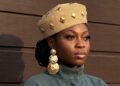
I’m gonna be so fr. When I first saw Ayo Edebiri’s Paper cover, my brain immediately thought: Warhol.
The way he’d take a photograph and let the color sit slightly wrong—the skin a little faded, the lips too red, the eyeshadow placed as someone hand-tinted it after the fact. You’re never quite sure if you’re looking at a person or a painting of a person.
That’s what Jaša Müller did here. Ayo’s skin doesn’t look like her usual dark skin. It looks like it’s fading, like the color is draining out of it on purpose. Her lips are vivid, almost too red. The slight red and blush pink on her eyelids sit like they were added later, by hand. The whole thing exists in this space between photograph and artifact.
One person on Twitter said it looks like a 70s SNL portrait. Another said it looks like papier-mache. Both are reaching for the same thing: an image that looks made, not manufactured. Something that shows its hand. Something that feels like it was built, not just produced.
Why It Resonates

Fashion covers do not usually generate this level of conversation. People scroll past them. They register, then disappear. This one is sticking because it does something unexpected.
The Paper interview that accompanies the cover gives some context. Ayo was in rehearsals for her Broadway debut in Proof, opposite Don Cheadle, when the shoot happened. She talks about the play, about making theater accessible, about growing up watching Tony performances alone in her room.
That background matters. The cover does not look like someone who showed up to a studio to fulfill a brand obligation. It looks like someone who knows how to hold a frame because she has spent her life thinking about performance.

The images are styled in Chanel Spring Summer 2026, photographed by Jaša Müller, with beauty by Chanel. But they do not look like a standard Chanel campaign. They look like they were made for her, not just put on her.
That’s why people are losing their minds. And why “this is what Vogue thinks it’s giving” hit so hard, because we all know exactly what they mean.